Introduction
AEO focuses on making your business’s content the direct, authoritative answer that AI tools like ChatGPT, Google AI Overviews, and Perplexity deliver to users. For businesses in competitive markets like Alabama’s Gulf Coast, AEO isn’t just an add-on—it’s a strategic necessity to stay visible and relevant.
Let’s explore what AEO is, why it’s gaining traction, how to determine if it’s the right fit for your business, and practical steps to implement it. Whether you’re a local service provider, e-commerce retailer, or B2B firm, understanding AEO can transform your digital presence. At YellowHammer IT, we specialize in integrating AEO into holistic digital marketing and website strategies to drive real results.
What is Answer Engine Optimization?
Answer Engine Optimization (AEO) is the process of structuring and enhancing your website’s content so that AI-powered “answer engines” can easily identify, trust, and cite it in response to user queries. Unlike SEO, which aims to rank your site in a list of links, AEO targets zero-click experiences where AI provides concise answers directly, often pulling from your content without users visiting your site.
Key Differences of AEO
AEO prioritizes clear, factual responses to questions (e.g., “How to prevent fleas in Alabama pets?”) over keyword-stuffed pages. It accounts for how AIs like large language models (LLMs) process information, favoring structured data, expertise signals, and user intent. With AI handling 25-30% of searches by 2026 (per industry forecasts), businesses ignoring AEO risk losing visibility as users shift from traditional search to conversational AI.
For example, a veterinary clinic in Foley, AL, could optimize content on pet vaccinations to appear in AI responses, attracting local clients without relying solely on Google rankings.
Search Engine Optimization (SEO) vs.
Answer Engine Optimization (AEO)
Comparison Matrix
| Aspect | SEO | AEO |
|---|---|---|
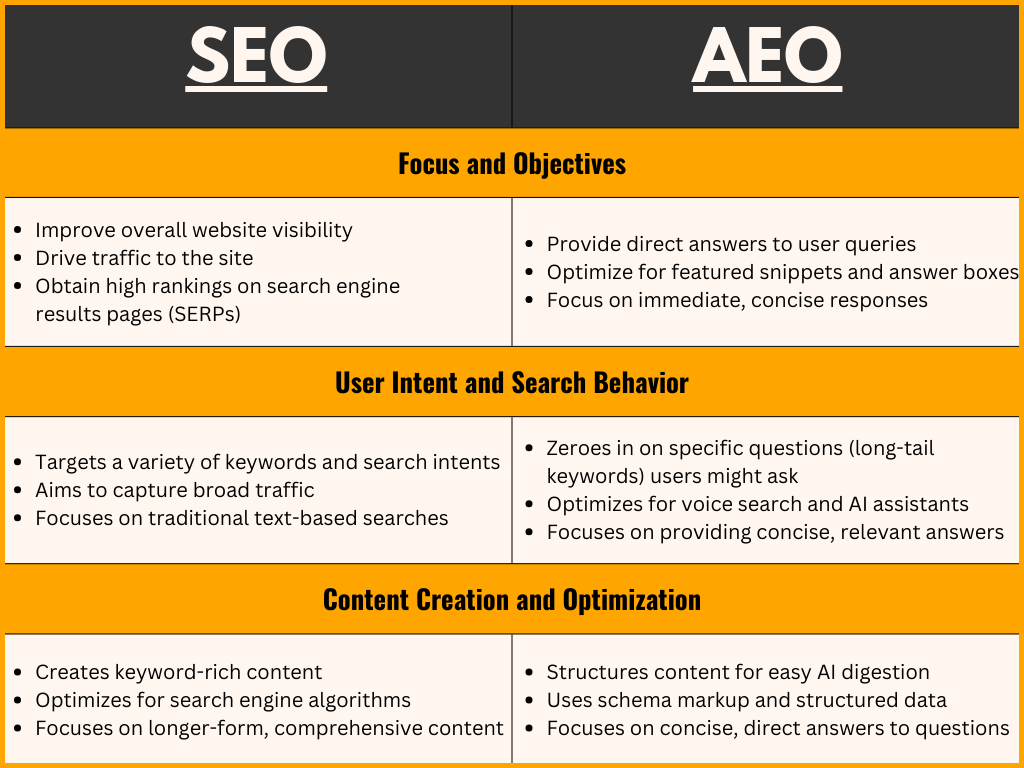
| Focus | Emphasizes keyword-stuffed pages and ranking in search result lists to drive clicks. | Prioritizes clear, factual responses to specific questions (e.g., “How to prevent fleas in Alabama pets?”) for direct, zero-click answers. |
| Centricity | Targets traditional search engines like Google, focusing on algorithms for link-based rankings and crawlability. | AI-centric, accounting for how large language models (LLMs) process information, favoring structured data, expertise signals, and user intent. |
| Importance and Future Outlook | Established for driving traffic through search rankings, but may lose ground as AI shifts user behavior. | Rising rapidly, with AI handling 25-30% of searches by 2026 (per industry forecasts); ignoring it risks losing visibility as users move to conversational AI. |
Why AEO Matters for Websites?
The surge in AI adoption is undeniable. Nearly 36% of people now use AI tools every day, with over 1 billion individuals engaging with generative AI platforms each month for quick, conversational answers.
This shift has profound implications, including reduced click-through rates as users receive instant responses that bypass websites unless your content serves as the authoritative source. Abundant opportunities for local and niche businesses, such as those in Alabama’s coastal regions or sectors like IT services and healthcare, to dominate AI-generated replies for targeted queries; and a significant competitive edge for early adopters, who often experience 20-30% boosts in organic traffic and leads as AIs prioritize and cite reliable, expert-driven information.
AEO comes with its own hurdles, demanding consistent creation of fresh, high-quality content alongside technical enhancements, which makes it particularly suited for businesses committed to long-term digital investment and growth.

How to Know If AEO is Right for Your Business Website
Not every business needs AEO immediately, but it’s particularly valuable for those meeting these criteria. Evaluate your operations against the following to decide:
Content-Driven Model
If your business website relies on informational content (e.g., blogs, FAQs, guides), AEO can amplify reach. Ask: Do customers frequently search for advice related to your services? For IT firms like YellowHammer IT, optimizing for queries like “best cybersecurity practices for small businesses in Alabama” could position them as an expert. If you don’t have content on your site yet, start building it with blogs and pages. We can help with adding content to your site too!
Local or Niche Focus
AEO excels for location-specific or specialized queries. If you’re a regional player (e.g., serving Foley or Baldwin County), AI tools often prioritize local insights. Signs it’s right: High competition in local search, or industries like veterinary care, real estate, or tech consulting where users seek quick, tailored answers.
Audience Behavior
Analyze if your target customers use AI assistants. Tools like Google Analytics can reveal search trends—look for rising voice or conversational queries. If over 40% of your traffic comes from informational searches, AEO is a fit.
Resource Readiness
Do you have the bandwidth for content creation and technical updates? AEO suits businesses with in-house marketers or partners like YellowHammer IT. Budget indicator: If you’re already investing in SEO (e.g., $1,000+/month), reallocating 20-30% to AEO could yield higher ROI.
Performance Metrics
Review current visibility, test queries in AI tools. If competitors’ content appears but yours doesn’t, AEO can bridge the gap. Red flags for delay: Purely transactional sites (e.g., simple e-commerce without educational content) or startups with minimal online presence.
AEO is ideal if your business educates customers, operates locally, and aims for thought leadership. For YellowHammer IT clients, we’ve seen AEO boost lead generation by 25% for service-based businesses.

How to Get Started with AEO
Implementing AEO doesn’t require a complete overhaul—businesses can start small and scale incrementally, allowing for manageable integration into existing digital strategies without disrupting operations. This approach minimizes risk while building momentum, enabling teams to test tactics, measure early wins, and refine efforts based on real-world results.
Here’s our 4 phased approach tailored for efficiency, drawing from our expertise in guiding clients through AI-optimized transformations.
By following these four phases, your business can systematically implement AEO, turning informational content into a powerful driver of visibility and leads in an AI-dominated search world we are moving into.
Phase 1: Audit and Research
Assess your website
Identify high-potential pages (e.g., services, blog) using tools like SEMrush or Ahrefs.
The foundation of any successful AEO strategy begins with a thorough audit and research phase, where you gain a clear understanding of your current digital footprint and uncover opportunities for optimization. This step ensures your efforts are data-driven and targeted, avoiding wasted resources on low-impact areas. Start by assessing your website comprehensively:
Use free or paid tools like Google Analytics to review traffic patterns, bounce rates, and top-performing pages; for deeper insights, leverage SEO platforms such as SEMrush, Ahrefs, or Moz to identify high-potential pages (e.g., service descriptions, blog posts, or resource hubs) based on metrics like organic search volume, keyword rankings, and backlink quality. Pay special attention to content that already attracts informational traffic—pages answering “what,” “how,” or “why” questions, as these align perfectly with AEO’s emphasis on direct answers. For instance, if your site has a blog on cybersecurity tips, evaluate its engagement and relevance to local queries in Alabama.
Research queries
Use AI tools directly, ask questions your audience might pose and note cited sources. Focus on intent: Informational (what/how/why) queries are AEO goldmines.
Dive into query research to align your content with real user intent: Directly test AI tools like ChatGPT, Perplexity, or Google Gemini by inputting questions your audience might ask, such as “best IT solutions for small businesses in Foley, AL” or “how to secure data during hurricane season.”
Note the sources these AIs cite—analyze why they’re chosen (e.g., structured formats, local relevance, or expert authority)—and identify gaps where your content could outperform them. Focus on informational intent queries, which are AEO goldmines because they drive the majority of AI responses; categorize them using frameworks like the “user journey” (awareness, consideration, decision stages) to prioritize high-volume, low-competition opportunities.
Document findings in a simple spreadsheet: Columns for query, current top sources, your site’s relevance, and potential optimizations. This phase typically takes 1-2 weeks and sets the stage for targeted improvements, ensuring your AEO implementation is both efficient and effective for long-term visibility gains.
If you’re resource-constrained, YellowHammer IT can handle this audit for you, providing a customized report to kickstart your strategy.
Phase 2: Content Optimization
Structure for Answers
Lead with concise summaries, use bullet points, lists, and FAQs. For example, create a “Cybersecurity FAQs for Alabama Businesses” page with direct Q&A.
Once you’ve completed your audit and research, the Content Optimization phase is where the real transformation happens—refining your existing assets and creating new ones to make them irresistible to AI answer engines.
This step focuses on reformatting and enriching content to align with how AIs extract and deliver information: prioritizing clarity, brevity, and value. By doing so, you increase the likelihood of your site being cited directly in AI responses, which can lead to higher visibility and trust without users ever leaving the AI interface. Aim to spend 1-2 weeks here, starting with 3-5 priority pages identified in the audit, such as your services overview or blog archives. For businesses like those partnering with YellowHammer IT, this phase often yields quick wins, such as turning a generic IT services page into a go-to resource for local queries on data security in Alabama’s humid climate.
Begin by structuring your content for direct, scannable answers that AIs favor: Lead every relevant page or post with a concise summary (50-100 words) that immediately addresses the core question, followed by supporting details. For instance, on a page about cybersecurity, open with: “Small businesses in Alabama face unique cyber threats like phishing amplified by hurricane disruptions—here’s how to protect your data with multi-factor authentication and regular backups.” Then, incorporate user-friendly formats like bullet points for key tips, numbered lists for step-by-step guides, tables for comparisons (e.g., “Pros and Cons of Cloud vs. On-Premise Security”), and dedicated FAQ sections to mirror conversational queries.
A practical example: Create a “Cybersecurity FAQs for Alabama Businesses” page with direct Q&A pairs, such as “What are the top cyber risks in coastal areas? – Flood-related outages and remote work vulnerabilities; mitigate with encrypted VPNs and disaster recovery plans.” This not only caters to AI parsing but also improves user experience, potentially boosting dwell time and shares.
Enhance Uniqueness
Incorporate expert quotes, local data, or case studies to build authority.
To stand out from generic competitors, enhance uniqueness by weaving in elements that demonstrate expertise and relevance: Incorporate quotes from your in-house specialists (e.g., “As YellowHammer IT’s lead engineer notes, ‘In Baldwin County, we’ve seen a 15% rise in ransomware due to outdated systems—proactive patching is key.'”), local data from sources like Alabama’s cybersecurity reports or your own analytics, and real-world case studies showcasing successes (e.g., “How we helped a Foley retailer recover from a breach in under 24 hours”).
This builds authority signals that AIs value, such as E-E-A-T (Experience, Expertise, Authoritativeness, Trustworthiness), making your content more likely to be selected over others. Tools like Grammarly for polishing or Canva for visual aids can help here, but focus on originality—avoid AI-generated text to prevent detection and penalties.
If you’re short on time, YellowHammer IT offers content audits and rewrites, ensuring your optimizations are tailored to your industry and region for maximum impact in the AEO landscape.
Phase 3: Technical Implementation
Add Schema Markup
Use JSON-LD for FAQs, LocalBusiness, or HowTo schemas via plugins (e.g., Yoast for WordPress).
With your content now optimized for clarity and relevance, the Technical Implementation phase shifts focus to the backend enhancements that make your site more discoverable and trustworthy to AI engines.
This step involves adding structured data and refining site performance, which helps AIs accurately interpret and prioritize your content,often leading to more frequent citations in responses. By addressing these technical elements, you not only boost AEO effectiveness but also improve overall user experience and traditional SEO rankings.
Plan for 1-2 weeks here, targeting the pages optimized in the previous phase; for instance, apply these tweaks site-wide but start with high-priority areas like your homepage, services, and FAQs.
At YellowHammer IT, we emphasize that this phase can deliver measurable uplifts in AI visibility, such as increased featured snippets or direct answer pulls, especially for local businesses in competitive areas like Foley, AL, where schema for location-based queries can make a significant difference.
Kick off by adding schema markup, a critical AEO tool that provides AI engines with explicit context about your content in a machine-readable format: Opt for JSON-LD (JavaScript Object Notation for Linked Data) as it’s the most flexible and recommended by Google, allowing you to embed structured code directly into your site’s HTML without altering the visible layout.
Key schemas to implement include FAQPage for Q&A sections (e.g., marking up each question-answer pair to make them easily extractable), LocalBusiness for essential details like your address, hours, phone, and reviews (ideal for regional firms to dominate local AI queries like “IT services near Gulf Shores”), and HowTo for instructional content (e.g., “How to Implement Basic Cybersecurity for Your Alabama Business” with step-by-step markup).
If your site runs on WordPress, use user-friendly plugins like Yoast SEO, Rank Math, or Schema Pro to generate and insert this markup automatically—simply input your data, and the plugin handles the code.
For other platforms (e.g., Shopify or custom CMS), add it manually via Google’s Structured Data Markup Helper or hire a developer for custom scripts.
After implementation, validate with tools like Google’s Rich Results Test or Schema.org’s validator to ensure no errors, and monitor for issues using Google Search Console. This not only signals expertise to AIs but also enhances rich results in search, potentially increasing click-throughs as a bonus.
Improve Site Health
Ensure mobile-friendliness, fast load times, and HTTPS security, accessibility, all that normal website stuff for best practices.
Complement schema additions by improving overall site health to meet best practices that AIs and users demand: Ensure mobile-friendliness with responsive design—test via Google’s Mobile-Friendly Test tool, aiming for seamless experiences on devices where most AI queries originate (e.g., smartphones).
Optimize for fast load times by compressing images with tools like TinyPNG, enabling browser caching, and minimizing code bloat, target under 3 seconds using PageSpeed Insights, as slow sites are penalized in AI sourcing. Secure your site with HTTPS (switch via your host like GoDaddy or SiteGround if not already), which builds trust and is a non-negotiable for modern web standards. Don’t overlook accessibility:
Follow WCAG guidelines by adding alt text to images, ensuring keyboard navigation, and using tools like WAVE or Lighthouse to audit for issues like color contrast—accessible sites perform better in AI evaluations, as they demonstrate inclusivity and quality.
Finally, incorporate other normal website best practices, such as clean URL structures, XML sitemaps for better crawling, and robots.txt files to guide bots.
For YellowHammer IT clients, we conduct full technical audits and implementations, often uncovering hidden issues that could hinder AEO success, ensuring your site is robust, compliant, and primed for the answer economy.
Phase 4: Ongoing Monitoring and Iteration
Track Results
Monitor AI citations with tools like AirOps; aim for periodic content updates.
After laying the groundwork with audits, content tweaks, and technical upgrades, the Ongoing Monitoring and Iteration phase ensures your AEO strategy remains dynamic and effective in a rapidly evolving AI landscape. This continuous cycle involves tracking performance, making data-informed adjustments, and strengthening your site’s authority to maintain or improve visibility over time.
Unlike one-off optimizations, this phase treats AEO as a living process—regular check-ins prevent stagnation and allow you to adapt to new AI algorithm changes, user behaviors, or competitive shifts.
Dedicate time monthly or quarterly, depending on your business scale; for example, a local IT firm in Foley, AL, might review metrics after seasonal spikes in queries like “hurricane-proof data backups.”
At YellowHammer IT, we view this as the key to sustained ROI, with clients often seeing compounding benefits like 15-25% year-over-year growth in AI-driven leads through consistent iteration.
Start by tracking results to measure the impact of your AEO efforts and identify areas for refinement:
- Use specialized tools like AirOps, SEMrush’s Position Tracking, or even free options such as Google Search Console to monitor AI citations—set up alerts for when your content appears in responses from tools by testing key queries weekly (e.g., input “cybersecurity for Alabama small businesses” and check if your site is referenced).
- Aim for monthly content updates based on these insights:
- Refresh high-performing pages with new data, seasonal angles, or expanded sections (e.g., add a subsection on “AI threats in 2026” to a cybersecurity guide), while archiving or revamping underperformers.
- Track key metrics like citation frequency, organic traffic from AI referrals (via UTM parameters), and conversion rates; document progress in a dashboard using Google Sheets or tools like Data Studio for visualizations.
This proactive monitoring not only highlights successes, such as increased mentions in local queries, but also flags issues early, like content that’s being outranked due to fresher competitor updates.
Build Authority
Gather reviews, earn backlinks, and publish regularly.
To solidify long-term success, focus on building authority signals that AIs heavily weigh when selecting sources:
- Actively gather reviews by encouraging satisfied clients to post on Google My Business, Yelp, or your site—aim for a 4.5+ star rating, as high-trust signals boost citation likelihood (e.g., integrate review widgets on service pages).
- Earn backlinks through strategic outreach, such as guest posts on Alabama business blogs, partnerships with local chambers of commerce, or sharing case studies on industry forums.
- Commit to publishing regularly, target 1-2 pieces per month, like blog posts or updated guides, to signal freshness to AIs.
- For instance, create a content calendar around timely topics (e.g., “Seasonal Visitor Attraction Tips for Gulf Coast Businesses”) to keep your site relevant. Incorporate multimedia where possible, such as infographics or videos, to enhance engagement and shareability.
By consistently building these elements, you’ll create a virtuous cycle where stronger authority leads to more AI citations, further amplifying your reach.
If managing this ongoing work feels overwhelming, YellowHammer IT provides managed AEO services, including automated monitoring reports and content planning, to keep your strategy on track and evolving without draining your internal resources.
What's Next?
AEO represents the future of digital visibility, empowering businesses to thrive in an AI-first world. By determining if it’s right for you and following these steps, you can position your brand as the go-to source for answers, driving sustainable growth.
Ready to integrate AEO into your holistic digital marketing and website plans? Contact YellowHammer IT, LLC today for a free consultation. Our experts in Foley, AL, will tailor an AEO strategy to your needs and budget.
Call us at: (251) 200-5020
Let’s optimize your business for the answer economy!
More Articles...

Contagious Digital Marketing: Applying the STEPPS Model

Vendor Tracking System for HOAs

Marketing Power of Professional Drone Photography and Videography

The 7 Level of an AI User: How to Level Up

The Art of the Push: Timely Course Launches

Digital Marketing: 4 Strategies to Boost Your Website

Common Pain Points for Universities

Cutting the Data Fog: Strategy for Clean Data