
M arketing in 2026 moves at the speed of a trending sound or a breaking news cycle. Yet, if your team is still operating on Drupal, you’re likely stuck in a "hurry up and wait" loop that feels like a relic of the past decade.
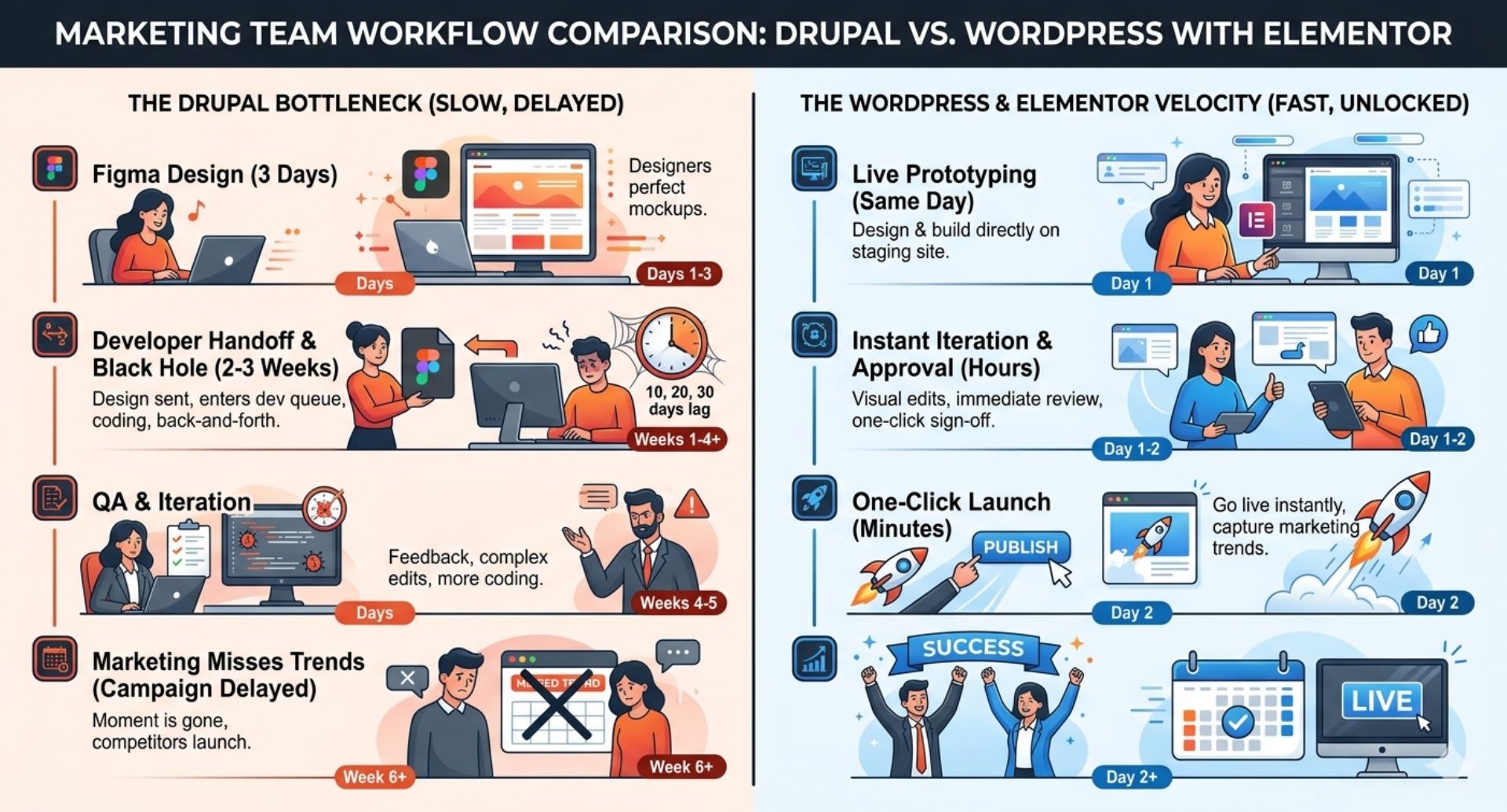
You know the routine: your designers spend days perfecting a high-fidelity mockup in Figma or other prototyping tools. You hand it off to the development team with high hopes, only to enter a black hole of technical tickets. By the time that "urgent" landing page, blog post, or white paper hub finally clears the development lag, the market trend has shifted, the moment is gone, and your competitors have already moved on to the next big thing.
While Drupal was once the go-to for complex enterprise structure, it has become a significant "drag" on modern marketing velocity:
If your marketing department feels "handcuffed" by a CMS built for experts rather than creators, you aren't alone. Global leaders like NASA, The White House, and Capgemini have already broken free. They didn’t just change their software; they eliminated the developer bottleneck entirely by moving to a platform that prioritizes marketing autonomy.
But how do you move from a rigid ticket-based system to a culture of instant results? It starts by reclaiming your velocity through a workflow centered on prototyping at the speed of thought.
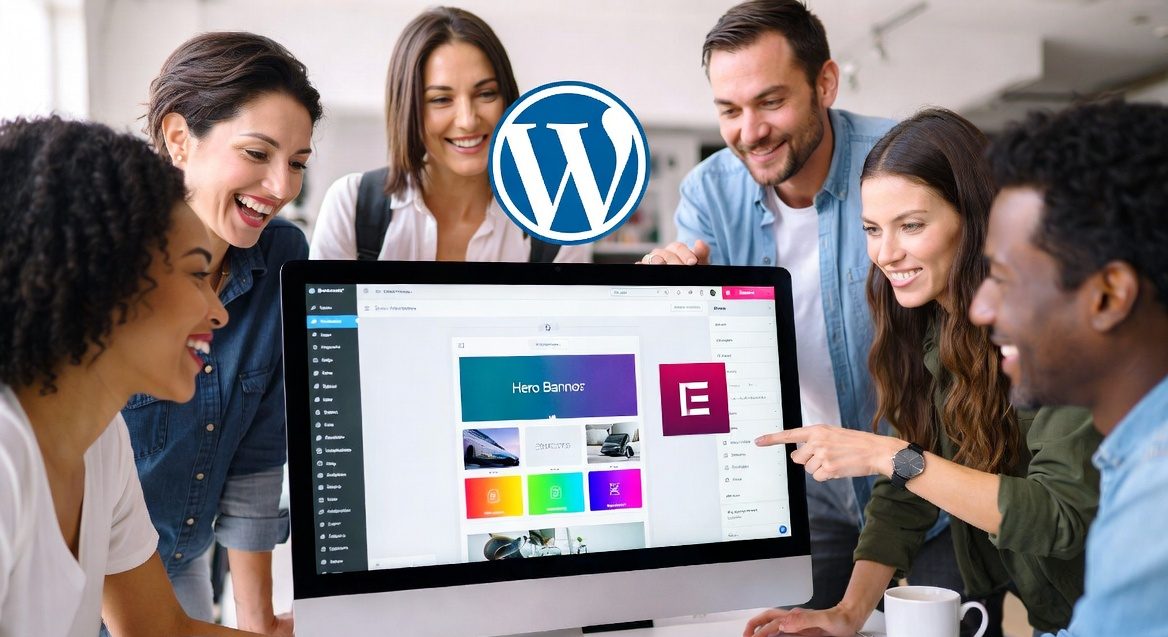
Imagine a workflow where your "mockup" is your live site. With Elementor on WordPress, the traditional 30-day lag evaporates because the design and development phases happen simultaneously:
Figma Design → Dev Queue → Coding → QA → 3 Weeks Later: Launch
Live Prototyping → Instant Iteration → 1 Click Approval → Same Day: Launch
Use Elementor to build landing pages and campaign hubs in real-time—no waiting for "translation" from Figma to code.
Your team can create, launch, and optimize content without filing a single developer ticket.
Change a headline, swap an image, or rearrange a layout globally in minutes, not days.
Use customized user roles (Editor, Author, Contributor) to move from "Draft" to "Approved" with professional oversight and zero chaos.
This isn't just about a "simpler" tool. It’s about velocity. When you replace Figma handoffs with a live WordPress environment, your marketing department transforms from a cost center waiting on tech into a high-speed production engine.
One of the biggest fears in moving away from a developer-gatekept system like Drupal is losing control. How do you maintain brand standards if everyone has "the keys"? The answer lies in replacing complex code with smart, role-based workflows that empower your team without creating a "Wild West" on your live site.
Instead of waiting for a developer to push code, your team moves through a structured internal pipeline using WordPress’s native capabilities and tailored approval plugins:
Content creators and designers build landing pages and blog posts directly in the visual editor. They can iterate and prototype, but they cannot hit "Publish" on their own.
Marketing leads review the live "Pending" content. They check for brand alignment, SEO, and legal compliance before giving the final green light.
This workflow doesn't just cut down on emails; it cuts out the "translation" lag. Your marketing team becomes a high-velocity production engine where ideas turn into live, optimized content in a single afternoon.
Now that you see how the workflow streamlines internal production, let’s look at how this speed directly impacts your bottom line, starting with your paid ad performance.
When you are paying for every click, every second of delay and every bit of generic content costs you money. In a rigid Drupal environment, marketers often settle for sending ad traffic to a general page because creating a custom, high-converting landing page takes too long. With WordPress and Elementor, you can build specific, laser-targeted landing pages for every campaign in a fraction of the time.
High-performing paid ads require a tight "message match" between the ad copy and the landing page. WordPress allows you to duplicate and customize layouts instantly to ensure your visitors see exactly what they were promised.
Stop wasting your ad budget on "close enough" pages. By moving the design process out of the developer queue and directly into your hands, you can ensure that every ad click lands on an experience that is relevant, functional, and optimized for conversion.
But the speed of your marketing is only half the battle. To maintain this growth, your platform must be as secure and stable as it is fast. Let’s look at the critical security gap and market shifts currently impacting the Drupal ecosystem.
A common myth is that you need the complexity of Drupal to handle massive traffic or high-security needs. In reality, some of the most visible and demanding organizations in the world have already migrated to WordPress to gain the very agility your team is missing.
When you use Elementor as your prototyping engine, you aren't just making "pretty pictures" in Figma; you are building actual, functional infrastructure.
By stripping away technical complexity, we do more than just save time; we clear the path for Human-Centered Design. Let's look at how this shift transforms the user journey into a performance multiplier.
In a complex user journey—whether it's a patient seeking care or a B2B lead evaluating software—every millisecond of "cognitive load" counts. WordPress + Elementor allows us to build Human-Centered experiences that Drupal’s rigid template structure simply can't match.
The "Template-First" Approach
Users are forced into rigid, pre-defined content types. If a specific landing page needs a unique flow to reduce friction, you must wait weeks for a developer to build a custom "module" or "block type."
The "User-First" Approach
We build around the user's intent. With visual drag-and-drop tools, we can iterate on the Information Architecture in real-time, testing different flows and CTAs to find the path of least resistance.
By moving to a flexible ecosystem, you stop fighting the CMS and start focusing on the person at the other end of the screen.
Relies on JavaScript "injections" and third-party scripts to deliver personalized ad content.
3rd-party script blocked by tracking protection. Content failed to render.
The user sees a generic page that doesn't match the ad they clicked.
Direct, hard-coded HTML/CSS landing pages built specifically for the ad click.
Native code loads instantly. The experience is exactly as designed.
Perfect "Message Match" leads to higher quality scores and more leads.
When you stop gambling with unstable scripts and start building with native speed, the ROI is measurable.
Let's look at a case study to see how one enterprise made this exact switch.
A mid-to-large scale enterprise partnered with YellowHammer IT, LLC to escape the "Drupal Bottleneck." With thousands of pages of legacy content and a complex user journey, they were losing weeks of marketing time to a developer-heavy ticket queue.
To ensure zero disruption, YellowHammer IT built a parallel Sandbox Environment. This allowed the organization to keep their live site running while the migration was carefully mapped and tested. Once the new WordPress + Elementor ecosystem was polished, we "flipped the switch" with no downtime.
Speed isn't just about software; it's about people. We trained the existing team on defined WordPress roles to ensure a high-velocity, secure pipeline:
Empowered to build and prototype landing pages instantly.
Trained to handle final QA and brand-governance using structured forms.
Overseeing the help desk and core site stability.
By eliminating the need for specialized Drupal coders, the company successfully restructured their digital team while accelerating their production cycle.
| Metric | Legacy (Drupal) | Modern (WordPress) |
|---|---|---|
| Technical Staffing | 12 Specialized Coders | 3 Admins / Help Desk |
| Time-to-Market (Campaign) | 18–30 Days | 24–48 Hours |
| Ticket Resolution Speed | 4.2 Days Avg. | 1.5 Days Avg. |
| Est. Annual Cost | $1.4M+ | $300k |
Annual Technical Savings: ~$1,100,000 (64% faster resolution)
*Estimations based on documented case studies and average enterprise technical salaries as of 2025.
While the cost and time savings are undeniable, the most critical reason for this shift isn't just about the bottom line, it’s about protecting your organization from the hidden vulnerabilities of a declining ecosystem. Beyond just the daily workflow friction, staying on Drupal presents a growing risk to your organization’s digital security and long-term viability. As the web moves toward more agile, visual-first platforms, Drupal’s market share has continued a decade-long decline, while its technical debt has increased.
For many, the biggest risk is End-of-Life (EOL). Drupal 7 reached its final end-of-life in early 2025. Sites remaining on these versions no longer receive official security updates, leaving them vulnerable to exploits unless they undergo a near-total rebuild.
| Category | WordPress VIP + Elementor | Drupal |
|---|---|---|
| CMS Market Share (2026) | ~60% (Dominant Leader) | ~1.0% (Steady Decline) |
| Enterprise Compliance | HIPAA & FedRAMP Ready | Complex Manual Hardening |
| Core Vulnerabilities (2025) | 6 High-Profile Issues | ~15 High-Profile Issues |
| Security Path | Smooth, Managed Updates | Complex, Near-Rebuilds |
| Marketing Autonomy | High - Instant Visual Publishing | Low - Heavy Dev Dependency |
For organizations with high regulatory requirements, WordPress VIP provides a HIPAA-ready cloud environment. With FedRAMP Authority to Operate (ATO) and rigorous security protocols, it combines the marketing speed of WordPress with the ironclad compliance typically associated with legacy government systems.
The contrast in market share isn't just a number, it’s a reflection of where the talent and innovation are flowing. With 60% of the CMS market, WordPress ensures your platform is supported by a massive ecosystem. Conversely, Drupal's 1% share means a shrinking pool of experts and a higher cost of maintenance.
By moving to WordPress, you aren't just gaining speed; you are stepping into a massive, secure ecosystem with a broader talent pool and a significantly lower total cost of ownership.

Transitioning from a complex Drupal environment doesn't have to be a multi-month ordeal that halts your production. YellowHammer IT specializes in seamless migrations that move your content, media, and data into a high-performance WordPress + Elementor ecosystem with zero downtime. No matter where your company is located, our remote-first, high-efficiency process is designed to get your team building at lightning speed immediately.
If your Drupal site is currently acting as a bottleneck, 2026 is the year to reclaim your marketing velocity. Imagine launching your next campaign in hours instead of weeks, without a single developer ticket or Figma-to-code translation error.
Let us show you exactly how much faster your marketing department can move. Contact YellowHammer IT today for a free evaluation of your current setup.
Schedule Your Free AssessmentYour future on WordPress is brighter, faster, and far more productive. Let’s make it happen.
Have more questions? Reach out to our experts for a deep dive into your specific needs.
Drawing directly from these proven enterprise migrations, YellowHammer IT delivers safe, high-velocity transitions. Based in Foley, Alabama, we provide:
If global leaders like NASA (126k+ pages) and Capgemini (1,400+ creators) can achieve marketing autonomy on WordPress, your team can too.